If you have spent any meaningful time researching kitchen cabinets, you have encountered this question. Ready-to-assemble or pre-assembled? Flat-pack or fully built? Save money and put them together yourself, or pay more to have them arrive ready to install?
The internet offers strong opinions on both sides. Cabinet retailers promoting pre-assembled products will tell you that assembly is difficult, time-consuming, and risky for untrained homeowners. Suppliers of RTA cabinets will tell you that pre-assembled cabinets are an unnecessary expense that delivers no additional quality. Neither perspective is entirely honest.
This guide is. We are going to walk through every meaningful difference between RTA and pre-assembled cabinets — cost, quality, shipping, assembly, and long-term performance — so you can make the decision that actually serves your renovation rather than someone else’s sales target.
What RTA and Pre-Assembled Cabinets Actually Are
Before comparing the two, it helps to understand precisely what each term means in practice.
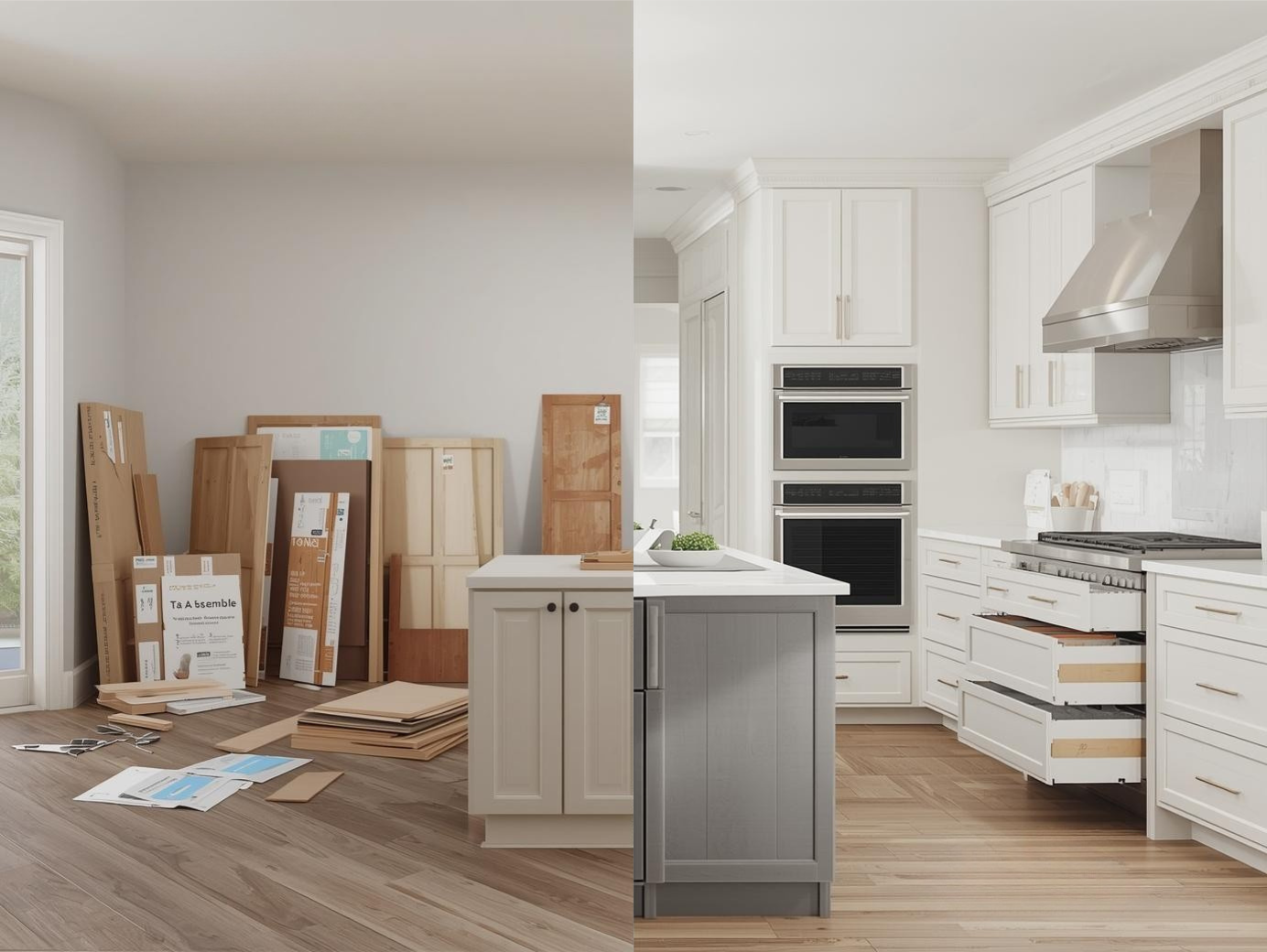
Ready-to-assemble cabinets arrive flat-packed. The cabinet box components — sides, top, bottom, back panel, and shelves — are packaged separately along with all necessary hardware, and the homeowner or installer assembles the box on-site before hanging or setting it in position. The doors, drawer fronts, and hardware are typically pre-attached or attached during installation. A standard RTA cabinet box can be assembled in fifteen to thirty minutes with basic tools.
Pre-assembled cabinets, sometimes called fully assembled or ready-to-install cabinets, arrive with the box already constructed. The cabinet ships as a single unit, requiring only positioning, securing to the wall, and attaching doors and hardware on-site. Installation moves faster once the cabinets arrive, but the cabinets themselves are significantly larger and heavier to ship.
Both types can be built from identical materials with identical construction standards. The distinction is entirely in the point at which assembly occurs — at the factory or at the job site. This is a critical point that most comparison guides bury or miss entirely, and it is the foundation of everything that follows.
The Cost Difference: What You Are Actually Paying For
The most common reason buyers choose RTA over pre-assembled is cost, and the savings are real and significant. Across comparable quality levels, RTA cabinets typically cost thirty to fifty percent less than pre-assembled equivalents from the same manufacturer.
That gap is not about material quality. It is about logistics.
A pre-assembled cabinet box occupies three to four times the shipping volume of the same cabinet shipped flat. Carriers charge by dimensional weight, which means shipping a pre-assembled kitchen of twenty cabinets costs dramatically more than shipping the same kitchen in flat-pack form. That cost is passed directly to the buyer. On a full kitchen order, the shipping differential alone can easily reach one thousand to two thousand dollars.
There is also a breakage and damage dimension to this calculation. Pre-assembled cabinets, because they ship as large, rigid, irregular shapes, are more vulnerable to transit damage than flat-packed components shipped in dense, properly protected boxes. A broken corner on a pre-assembled cabinet is a replacement claim and a project delay. A damaged panel from an RTA shipment is typically easier to replace quickly.
For buyers ordering on a defined renovation budget, the cost difference between RTA and pre-assembled from a comparable quality supplier is real money that can go toward better countertops, hardware upgrades, or professional installation labor.
The Quality Question: Is Pre-Assembled Actually Built Better?
This is the most persistent myth in the cabinet industry and it deserves a direct answer.
No. Pre-assembled cabinets are not inherently higher quality than RTA cabinets.
Quality is determined by the materials used and the construction standards applied. Plywood or particleboard. Solid wood or MDF door frames. Dovetail or stapled drawer boxes. Soft-close or standard hinges. These are the quality variables that matter for the life of a cabinet, and none of them are determined by whether the box arrives assembled or flat-packed.
A poorly made pre-assembled cabinet using particleboard construction and hollow-core doors will perform worse over ten years than a well-made RTA cabinet using plywood box construction, solid wood door frames, and dovetail drawer joinery. The assembly point is irrelevant. The materials and joinery are everything.
What pre-assembled does offer is manufacturing consistency in the box assembly. Factory assembly in a controlled environment with calibrated equipment produces tighter tolerances than on-site assembly by a homeowner working with basic tools for the first time. This is a real consideration, but it is largely neutralized when a professional installer handles the RTA assembly, which is the case in the majority of kitchen renovation projects.
The practical takeaway is straightforward. Buy the best materials your budget allows. Whether they arrive assembled or flat-packed is a secondary consideration.
Assembly: How Difficult Is It Really?
The most common concern buyers raise about RTA cabinets is the assembly process. The honest answer is that modern RTA cabinets are significantly easier to assemble than most buyers expect, and the learning curve is genuinely shallow.
Quality RTA cabinet systems use cam-lock assembly hardware, which requires no special tools beyond a basic screwdriver and a rubber mallet. Every piece is pre-drilled. Every component is labeled. The assembly sequence is logical, and most manufacturers provide detailed video walkthroughs that make the process accessible to anyone comfortable with basic household tasks.
A first-time assembler working carefully can typically complete a single RTA cabinet box in twenty to thirty minutes. An experienced installer assembles the same cabinet in eight to twelve minutes. For a full kitchen of fifteen to twenty cabinets, a professional installation team assembles and hangs everything in one to two days.
The assembly process also has an underappreciated benefit. When you assemble the cabinet box yourself or with your installer, you inspect every component individually before it goes into the wall. Damaged or defective parts are identified and addressed before installation rather than after, which is significantly less disruptive than discovering a problem in a pre-assembled cabinet once it is already mounted.
Shipping and Lead Time: Where RTA Wins Decisively
If your renovation has a deadline, this section matters more than almost anything else in this comparison.
RTA cabinets ship faster, arrive in better condition, and are easier to manage on a job site than pre-assembled equivalents. Flat-packed boxes are uniform, stackable, and compact. A full kitchen order fits neatly into a small delivery area. Components can be moved room to room easily without risk of damaging a fully assembled box.
Pre-assembled cabinets require careful staging, more storage space, and more labor to move through a renovation site. In smaller homes where space management during a renovation is already challenging, the physical footprint of pre-assembled cabinet delivery is a genuine logistical consideration.
Lead times are also typically shorter for RTA products. Because flat-packed products are more efficiently warehoused and shipped, in-stock RTA cabinets frequently ship within three to five business days. Pre-assembled products often carry longer lead times due to staging and shipping logistics.
For buyers with firm project timelines, contractor schedules to coordinate, and renovation windows to manage, the shipping and lead time advantages of RTA are practically significant.
Long-Term Performance: Which Lasts Longer?
Assuming equivalent materials and construction quality, there is no meaningful difference in long-term performance between RTA and pre-assembled cabinets. A plywood-box, solid-wood-door, dovetail-drawer cabinet will last thirty years or more regardless of whether it was assembled at a factory or on a job site.
The single variable that affects long-term performance specific to RTA assembly is the quality of the on-site assembly itself. Cam locks that are not fully tightened, rear panels that are not fully seated, or drawers that are misaligned during installation can create performance issues over time. This is not an RTA problem per se — it is an installation quality problem, which is equally present in poorly installed pre-assembled cabinets.
The solution is straightforward. If you are not confident in your own assembly skills, hire a professional installer. The labor cost is a fraction of the price difference between RTA and pre-assembled products, and the installation quality of an experienced cabinet installer is consistently superior to factory-assembled boxes where dimensional accuracy is more standardized but site-specific adjustments are impossible.
When Pre-Assembled Makes Sense
Pre-assembled cabinets are genuinely the better choice in specific circumstances, and intellectual honesty requires acknowledging them.
If you are renovating a single bathroom vanity location where speed is critical and shipping cost is minimal, the convenience premium of pre-assembled may be worth the additional expense. If you are a contractor working on multiple simultaneous projects where installation speed is a direct labor cost factor, pre-assembled cabinets can improve project economics even at a higher product cost. If the renovation timeline is extremely compressed and assembly time is genuinely not available, pre-assembled removes one constraint from an already demanding schedule.
These are real scenarios. For the majority of full kitchen renovations, however, where cost, quality, and material selection are the primary drivers, RTA from a quality supplier delivers everything pre-assembled offers at a significantly better price point.
The Buying Decision: What Actually Matters
After weighing every dimension of this comparison, the decision framework is simpler than most buyers expect.
If material quality, cost efficiency, and design selection are your priorities, and they should be for most kitchen renovations — buy the best quality RTA cabinets your budget allows and invest the savings into better countertops, professional installation, or upgraded hardware.
If installation speed is your absolute primary constraint and budget is not a meaningful consideration, pre-assembled may marginally reduce your timeline. Understand that you are paying a significant premium for a relatively modest convenience.
What should never drive this decision is the assumption that pre-assembled means higher quality. It does not. The materials in the box determine the quality of the cabinet. Everything else is logistics.
What to Verify Before Buying Either Type
Whether you choose RTA or pre-assembled, these are the non-negotiable quality standards that determine whether your investment performs for five years or thirty.
The cabinet box must be plywood construction. Not particleboard. Not MDF. Plywood’s cross-grain lamination provides structural integrity and moisture resistance that particleboard fundamentally cannot match in a kitchen environment. This is the single most important material specification in any cabinet purchase.
Drawer boxes should use dovetail joinery. Dovetail joints interlock mechanically without relying on fasteners or adhesive alone, creating a structurally superior connection that handles the repetitive stress of daily use without loosening or separating. Stapled or pocket-screw drawer construction is significantly weaker and a clear indicator of overall quality compromise.
Door frames should be solid hardwood. Maple, birch, and alder are the most common and most reliable species for painted and stained finishes in kitchen cabinetry. Solid wood holds hinge screws firmly, resists warping under humidity variation, and maintains finish integrity at corners and edges over decades of use.
Soft-close hardware should be included as standard, not offered as an upgrade. Any cabinet supplier who charges extra for soft-close hinges and drawer glides in 2026 is either cutting costs elsewhere or pricing their base product to conceal the true cost of a quality cabinet.
Finally, confirm the finish type on painted or stained products. A catalyzed or conversion varnish topcoat provides the scratch and chemical resistance needed for a kitchen environment. Standard air-dry finishes are softer and show wear significantly faster in high-traffic areas.
Our RTA Cabinets: Quality That Makes the Decision Easy
At Lmereody Cabinetry, every cabinet in our lineup meets the quality standards outlined above, regardless of whether you are furnishing a single bathroom or a complete kitchen renovation.
Our four flagship styles cover the full range of what the market is looking for in 2026. The DDW Double Dove White delivers the timeless, universally flattering white shaker kitchen that remains the most purchased cabinet configuration in the country. The GR Shaker Gray offers the sophisticated medium gray tone that interior designers consistently recommend for its versatility and practical durability. The NB Navy Blue is the bold, design-forward choice for homeowners ready to build a kitchen that genuinely stands out. The SWO Slim White Oak captures the natural wood movement that is driving the most admired kitchen renovations of the year.
Every product ships flat-packed for cost and transit efficiency, assembles with standard tools using a straightforward cam-lock system, and comes with soft-close hinges and drawer glides included as standard. Plywood box construction and solid wood door frames across the entire lineup. Free shipping on qualifying orders of $2,400 or more.
Before you place an order, our professional design team will provide a full-color 3D rendering of your kitchen layout based on your measurements at no charge. You see your finished kitchen before you commit to a single dollar of product spend.
👉 Browse Our Full RTA Cabinet Collection 👉 Get Your Free 3D Kitchen Design Today 👉 Order Sample Doors Before You Commit