The storage problem in most kitchens is not a square footage problem. It is a design problem.
Walk through any home with a kitchen that feels perpetually cluttered and undersized and you will almost always find the same pattern. Upper cabinets that are too full to access efficiently. Base cabinets that store items at the back where they cannot be reached without removing everything in front. Drawers organized by whatever was closest when the item was first put away. Counter surfaces occupied by things that do not have a cabinet home because the cabinet system was never designed around what the household actually needs to store.
The kitchen that works, where everything has a place and that place makes intuitive sense for how the kitchen is actually used, is not larger than the kitchen that does not work. It is organized differently. The cabinet configurations serve the storage applications they are intended for. The interior solutions maximize the functional capacity of every cubic inch of cabinet space. And the layout assigns storage to the positions closest to where the stored items are used.
These are solvable problems regardless of the size of the kitchen and regardless of whether the cabinets are being replaced as part of a renovation or optimized within an existing layout.
The Storage Problem Most Kitchens Have in Common
Before addressing specific storage ideas, understanding the structural reason most kitchen storage systems underperform is useful context for evaluating which solutions apply to your specific situation.
The majority of kitchen cabinet storage problems originate in the base cabinet. Not because base cabinets are poorly designed but because the default configuration, two doors with one or two fixed interior shelves, is the least storage-efficient format available. A base cabinet with fixed interior shelves nominally provides a certain volume of storage space. The volume that is functionally accessible, meaning the volume where items can be placed and retrieved without a secondary reorganization process, is substantially smaller than the nominal total.
Items at the back of a fixed-shelf base cabinet are effectively invisible and effectively inaccessible in a regularly used kitchen. The household knows they are there in a general sense but does not reach for them when cooking because doing so requires removing the items stored in front. The result is a kitchen where the front half of every base cabinet is in constant use and the back half accumulates forgotten items that would be used regularly if they were accessible.
Every storage idea in this guide is evaluated against this fundamental challenge: does it make the full storage capacity of the cabinet functionally accessible, or does it simply rearrange which items are inconveniently located?
Pull-Out Shelves: The Highest-Return Base Cabinet Upgrade
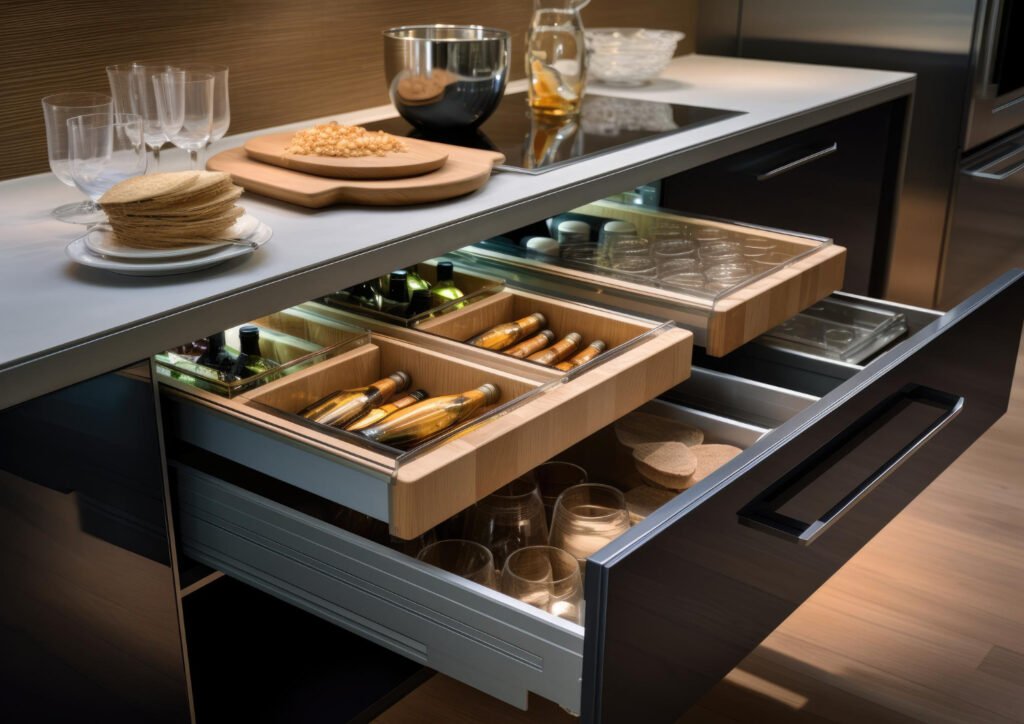
Pull-out shelves are the single most impactful storage upgrade available for any base cabinet with a door-and-shelf configuration. The mechanism is straightforward: a shelf mounted on full-extension drawer glides extends to the full depth of the cabinet when pulled, bringing every item stored on the shelf to the front of the cabinet where it is fully visible and fully accessible.
The difference between a fixed shelf and a pull-out shelf in daily use is not marginal. A fixed shelf in a twenty-four-inch-deep base cabinet provides twelve to fourteen inches of functionally accessible depth before items begin stacking in front of other items. A pull-out shelf in the same cabinet provides the full twenty-two inches of usable shelf depth simultaneously, with every item accessible without moving anything else.
For base cabinets storing pots, pans, and heavy cookware, pull-out shelves transform the cooking equipment storage experience entirely. The specific pan needed for a specific task is no longer buried under three other pans. It is visible on the pulled-out shelf and retrievable in a single motion.
Pull-out shelves can be added to existing base cabinets as an aftermarket addition or specified as part of a new cabinet order. When planning a kitchen cabinet order with our free design service, pull-out shelf positions can be specified in the base cabinet layout before the order is placed, which is the most cost-effective way to include this feature.
Drawer Bank Configurations: Better Than Pull-Outs for Everyday Items
For everyday cooking equipment, utensils, flatware, and kitchen supplies that are accessed multiple times during a single cooking session, a drawer bank base cabinet provides even better storage performance than a pull-out shelf in the same position.
A drawer bank replaces the two-door-and-shelf configuration with three or four stacked drawers that occupy the full height and width of the base cabinet opening. Each drawer opens fully, displays all of its contents simultaneously from above, and closes with the soft-close glide that protects both the drawer and the cabinet structure from repeated impact.
The practical advantage of drawer storage over shelf storage for everyday items is complete simultaneous visibility. When a drawer is opened, every item in it is visible at once without any item being behind or underneath another item. The spatula, the tongs, the wooden spoon, and the whisk are all visible and reachable from the same position without a search process.
For households replacing existing cabinets, specifying drawer bank configurations in the base cabinet positions adjacent to the range and in the primary preparation zone delivers the most immediate and most consistently appreciated improvement in daily kitchen function. Our DDW Double Dove White and GR Shaker Gray base cabinets in drawer bank configurations are among the most frequently requested units from customers who have previously lived with door-and-shelf alternatives.
Vertical Storage for Flat and Thin Items
Cutting boards, baking sheets, muffin tins, cooling racks, and pan lids share a storage challenge that neither shelves nor drawers address elegantly: they are flat, thin, and awkward to stack. A stack of cutting boards requires removing every board above the one being retrieved. A pile of baking sheets requires the same inefficient extraction process. Lids stored without dividers slide and shift until the stack collapses when the cabinet is opened.
Vertical dividers solve this problem by storing flat items standing upright rather than stacked horizontally. A vertical divider system in a base cabinet or tall cabinet position creates individual slots for each item where any item can be retrieved without disturbing the others. The organization maintains itself because items stand independently rather than stacking dependently.
Vertical divider storage works in both base cabinet and wall cabinet positions. In a base cabinet adjacent to the oven, vertical dividers for baking sheets and muffin tins create dedicated slots for each piece at the position where they are used. In a wall cabinet above the preparation area, vertical dividers for cutting boards keep them organized, visible, and individually accessible.
The Corner Cabinet: Converting the Most Wasted Space in the Kitchen
The corner base cabinet is the most consistently underperforming storage position in any kitchen layout. The standard corner cabinet configuration, two doors opening onto a deep interior that is accessible only with difficulty at the back corners, creates a position where items are stored but not truly accessible. Most households use the front eighteen inches of a corner cabinet regularly and abandon everything behind it.
Three solutions convert corner cabinet space from a storage liability into a storage asset, and each is appropriate for different kitchen layouts and renovation scopes.
A full-circle lazy Susan, where two or more circular shelving tiers rotate on a central pole, brings the full depth of the corner cabinet to any access position by rotating the shelves to the front of the cabinet opening. Every item stored on the lazy Susan is accessible without reaching or repositioning other items. The limitation of a standard lazy Susan is the dead space behind the cabinet door hinges where items cannot be placed, which reduces the total usable storage area of the rotating shelves.
A kidney-shaped or D-shaped lazy Susan addresses the hinge dead-space limitation by shaping the shelves to swing clear of the door frame as they rotate. This configuration provides more usable rotating shelf area than a standard circular lazy Susan and works in the same corner base cabinet opening.
A full-extension corner pull-out system, which is the most expensive but most storage-efficient corner solution available, uses two shelving tiers mounted on extension hardware that swing out and forward when the cabinet door is opened. This brings the full depth of the corner cabinet to the front of the cabinet opening simultaneously, providing access to every stored item without any rotation required.
Ceiling-Height Wall Cabinets: The Overhead Storage Most Kitchens Miss
The space between the top of standard thirty-inch wall cabinets and the kitchen ceiling is one of the most universally wasted storage opportunities in the standard kitchen. In a kitchen with eight-foot ceilings, this gap represents twelve to eighteen inches of vertical wall space that a standard wall cabinet layout leaves entirely unused. In a kitchen with nine-foot ceilings, the unused space grows to twenty-four inches or more.
Ceiling-height wall cabinets, or stacked wall cabinets where a shorter unit is installed above the primary wall cabinet run, convert this space into organized storage. The upper position is best suited for items accessed infrequently, which means reach height is not the primary consideration. Seasonal items, backup supplies, large serving pieces used for special occasions, and the small appliances that are used occasionally rather than daily are all appropriate candidates for upper cabinet storage.
The visual benefit of ceiling-height cabinets is equally significant in small kitchens where the continuous vertical line from countertop to ceiling creates the impression of a larger, more finished space. Our DDW Double Dove White in ceiling-height configuration is one of the most consistently effective visual strategies for compact kitchen renovation because the bright white finish reflects the additional light created by the taller cabinet surface while the ceiling-height coverage eliminates the visual discontinuity of a gap between the cabinet top and the ceiling.
Door-Mounted Interior Organizers: Storage Space That Costs Nothing Extra
The interior surface of every cabinet door is vertical storage space that standard cabinet interiors leave completely unused. Door-mounted organizers convert this surface into functional storage for the small, frequently accessed items that otherwise compete for shelf and drawer space.
On the inside of a pantry or tall cabinet door, a door-mounted organizer accommodating spice jars, small condiment containers, foil and wrap boxes, or cleaning supply bottles adds meaningful storage volume to a cabinet position without requiring any additional floor or shelf footprint. On the inside of a base cabinet door adjacent to the range, a door-mounted lid holder keeps pan lids organized and individually accessible rather than stacked in a precarious arrangement on an interior shelf.
The practical impact of door-mounted storage is proportionally larger in smaller kitchens where every additional storage position creates meaningful additional organized capacity. In a larger kitchen, door-mounted storage adds convenience. In a compact kitchen, it can make the difference between a kitchen that stores everything the household needs and one that is perpetually short on organized space.
Planning Storage Before You Order
The most powerful position from which to optimize kitchen cabinet storage is before the cabinet order is placed rather than after the cabinets are installed. Configuration choices made at the ordering stage, specifically the allocation of base cabinet positions between door-and-shelf units, drawer bank units, and pull-out configurations, have a larger impact on the total functional storage capacity of the kitchen than any interior accessory added after installation.
Our free design service includes storage consultation as part of the 3D kitchen rendering process. When you submit your kitchen measurements, our design team asks about your storage priorities, your cooking patterns, and the specific storage problems you want the renovation to solve. The cabinet layout in your 3D rendering reflects those priorities in the configuration choices made at each cabinet position, not just in the color and style of the door fronts.
The result is a kitchen that is designed to store what your household needs to store, in the positions where those items are used, in configurations that make every stored item accessible without a search process. That is not a detail of the renovation. It is the renovation.
👉 Browse Our Full Cabinet Collection 👉 Get Your Free Kitchen Storage Design Consultation 👉 Order Sample Doors Before You Commit
The Kitchen That Stores Everything Without Effort
The kitchen storage system that works is not the one with the most cabinet space. It is the one where the cabinet space that exists is fully accessible, logically organized, and positioned where the household actually uses the items stored within it.
Pull-out shelves that bring every stored item to the front. Drawer banks that make everyday equipment visible and reachable simultaneously. Vertical dividers that solve the flat-item stacking problem permanently. Corner solutions that convert the most wasted cabinet position into genuine storage. Ceiling-height cabinets that recover the overhead space standard layouts abandon. Door-mounted organizers that add storage volume without adding footprint.
These are not extraordinary measures. They are the design decisions that separate a kitchen with storage space from a kitchen with storage that works. And they are all available in the cabinet configurations and products we build every kitchen around.
Start with your measurements. Get your free storage-first design. Build the kitchen that stores everything you need without a search every time you cook.