🚚Free delivery on orders above $500 β€’ πŸͺ΅Premium custom cabinets crafted with precision β€’ πŸ“žCall us today for a free design consultation β€’ ✨Luxury finishes. Tailored spaces. Timeless style. β€’ πŸ’³Flexible payment options available β€’ 🚚Free delivery on orders above $500 β€’ πŸͺ΅Premium custom cabinets crafted with precision β€’ πŸ“žCall us today for a free design consultation β€’ ✨Luxury finishes. Tailored spaces. Timeless style. β€’ πŸ’³Flexible payment options available β€’

Cheap Kitchen Cabinets: What You Can Actually Get for Less and What Will Cost You More in the End

The search for cheap kitchen cabinets is one of the most common starting points in any kitchen renovation budget conversation. And it is a completely understandable one. Kitchen renovations are expensive. The cabinet portion of that expense is consistently the largest single line item. The instinct to find the lowest possible price for the largest single cost in the project is financially rational.

The problem is not the instinct. The problem is that the cheapest kitchen cabinets on the market are not cheap over time. They are cheap at the point of purchase and expensive over the period of ownership because their material limitations create failures, frustrations, and eventual replacement costs that the initial price saving did not account for. A cabinet that costs four hundred dollars and requires replacement in seven years has a different total cost than a cabinet that costs six hundred dollars and performs reliably for thirty years. The apparent saving at purchase erodes entirely and then reverses over the ownership period.

This does not mean that finding genuinely affordable kitchen cabinets is impossible. It means that the search for affordable kitchen cabinets should be guided by what drives genuine value rather than what drives a low sticker price. Those are two very different things, and understanding the difference is worth more than any comparison chart of initial prices.

Β 

Why the Cheapest Kitchen Cabinets Cost More Over Time

The cheapest kitchen cabinets in the market share a small number of construction characteristics that determine their limited service life regardless of how they are presented, marketed, or priced in any specific retail context.

Particleboard box construction is the primary material decision that separates genuinely cheap cabinets from genuinely affordable ones. Particleboard, which is compressed wood fiber and adhesive, costs less than plywood to manufacture and produces a cabinet box that looks structurally sound from the outside for several years. Beneath the surface, its performance under the conditions of a real kitchen environment tells a different story.

Kitchens are humid environments. Cooking, dishwashing, and daily use create humidity variation that the cabinet box materials absorb and release repeatedly over the life of the kitchen. Plywood, with its cross-grain laminated construction, handles this absorption and release cycle with minimal dimensional change because the alternating grain directions of adjacent layers resist expansion in any single direction. Particleboard handles the same cycle by swelling, which causes the material to swell at seams and edges, lose its screw-holding capacity at hinge and hardware mounting points, and eventually degrade structurally in the areas of highest moisture exposure.

In a kitchen used regularly by an average household, particleboard cabinet boxes typically begin showing these failure modes between five and eight years after installation. The failures are not dramatic initially. Drawers that begin to stick. Hinges that no longer hold their adjustment. Shelves that develop a slight bow. But the trajectory from the first signs of particleboard failure to the point where the kitchen requires cabinet replacement is consistently shorter than the homeowner expected when the initial purchase was made.

Stapled drawer boxes are the second most consequential construction limitation in the cheapest kitchen cabinets. A drawer box with stapled corners has no mechanical interlock between its components. The staples hold the corners together adequately when the drawer is new and lightly loaded. Under the repetitive stress of daily use with a full load of kitchen equipment, the stapled corners loosen progressively until the drawer box racks, the drawer front misaligns, and the joint eventually fails.

Standard hinges without soft-close are not the catastrophic failure point that particleboard boxes or stapled drawers represent, but their presence is one of the most reliable indicators that the other cost-cutting decisions described above are also present in the same cabinet. A manufacturer confident enough in their product quality to use soft-close hardware as a standard specification has almost certainly made equally considered decisions throughout the rest of the product.

affordable kitchen cabinets, cheap kitchen cabinets good quality, inexpensive kitchen cabinets, budget kitchen cabinets 2026

What Genuinely Affordable Kitchen Cabinets Actually Look Like

The genuinely affordable kitchen cabinet exists in the market. It is not the cheapest cabinet available and it is not the most expensive. It is the cabinet that meets the construction standards that determine long-term performance while eliminating the overhead costs that drive cabinet prices above the point where those standards are actually delivered.

The construction standards that separate genuinely affordable quality from apparent bargains are the same four specifications that appear throughout our buying guides. Plywood box construction. Solid wood door frames. Dovetail drawer box joinery. Soft-close hinges and drawer glides as standard.

A cabinet that meets all four of these standards at any price point is a cabinet worth considering. A cabinet that fails on any one of them at any price point is a cabinet whose initial savings will be consumed by the costs of premature failure.

The overhead costs that drive cabinet prices above the quality threshold without adding material value are the costs of traditional cabinet retail. Showroom facilities, commissioned sales staff, designer fee structures, pre-assembled inventory storage and shipping costs, and brand premium are all costs that appear in the price of a showroom cabinet without appearing in the quality of its construction. An efficient RTA supplier who eliminates those overhead costs while maintaining the same construction standards delivers genuinely affordable quality rather than cheap construction dressed in a competitive price.

This is the model that makes our cabinets the answer to the cheap kitchen cabinet search. Not cheap construction at a low price, which is what most of the lowest-priced cabinets on the market represent. Genuinely quality construction at a price made competitive by eliminating the overhead rather than the materials.

How to Evaluate Cheap Kitchen Cabinets Before You Buy

Every cabinet purchase, regardless of the price being considered, should be evaluated against the same four construction standards. These are the questions to ask of any cabinet supplier before placing an order at any price point.

Is the cabinet box plywood or particleboard? This is the most important question and the one whose answer most directly predicts the service life of the cabinet in a kitchen environment. The answer should be plywood throughout the box construction, including the sides, top, bottom, and back panel. Any answer that introduces particleboard into the box construction is a disqualifying response regardless of the price.

What is the drawer box joinery? The answer should be dovetail. Box joint or finger joint construction is a reasonable second choice that provides a mechanical interlock without the full wedging strength of a dovetail. Pocket screw, staple, or nail construction is the answer that predicts early drawer failure in a regularly used kitchen.

Is soft-close hardware included as standard? The answer should be yes, included in the standard product without upgrade pricing. Any answer that positions soft-close as an optional addition tells you that the supplier’s standard product does not meet the baseline specification for a quality kitchen cabinet.

What species is the door frame? The answer should identify a specific hardwood species β€” maple, birch, or alder are all appropriate for painted finishes. An answer that references MDF, composite material, or simply does not address the door frame material is a signal that the door construction does not meet the solid wood standard.

A cabinet that answers all four questions satisfactorily is a genuinely affordable cabinet worth purchasing if the price is competitive. A cabinet that fails on any one of the four is not a bargain at any price.

The Price Range Where Genuine Quality Becomes Genuinely Affordable

Quality RTA kitchen cabinets that meet all four construction standards are available at prices that genuinely competitive buyers find surprising once they understand what drives the gap between RTA pricing and traditional retail pricing for equivalent construction quality.

A standard ten by ten kitchen cabinet set meeting the plywood box, solid wood door, dovetail drawer, and soft-close hardware specifications typically costs between two thousand and five thousand dollars from a quality RTA supplier. The same kitchen from a traditional showroom retailer using equivalent construction standards typically costs between eight thousand and fifteen thousand dollars. The difference is almost entirely overhead rather than material quality.

Free shipping on qualifying orders of $2,400 or more at Lmereody Cabinetry removes the freight cost that often erodes the pricing advantage of online RTA suppliers. Free professional design service removes the design consultation cost that traditional retailers either charge separately or embed in the product price. Sample doors available before the full order allow quality verification in person before the renovation budget is committed.

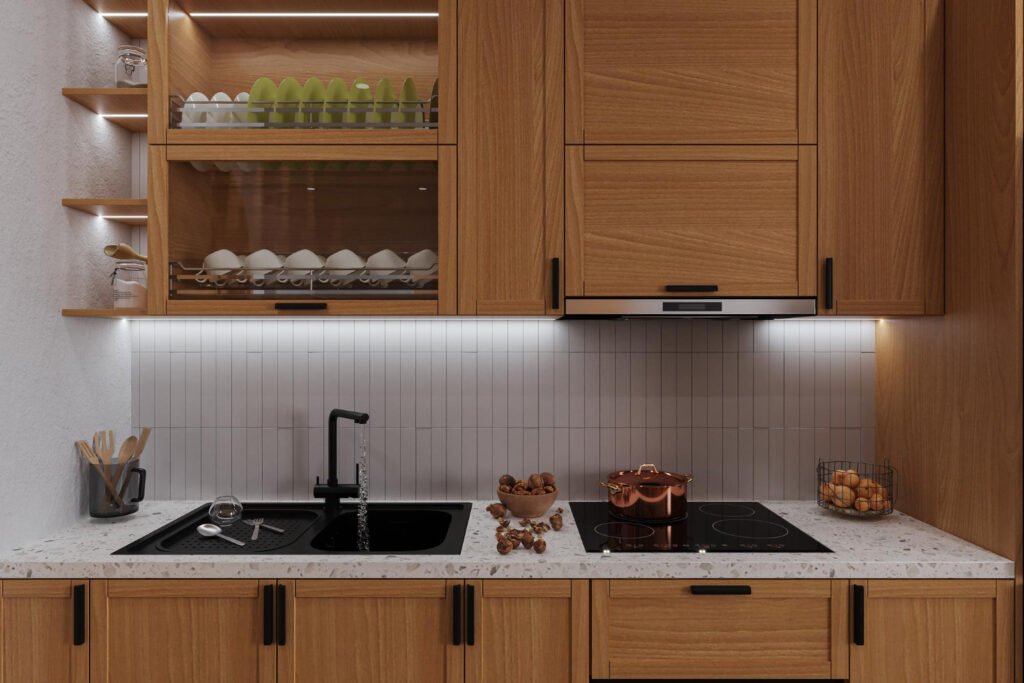
Our DDW Double Dove White delivers the most universally purchased white shaker kitchen at a price that consistently surprises buyers comparing it to showroom alternatives with equivalent construction. The GR Shaker Gray provides the sophisticated gray shaker result at the same quality standard. The NB Navy Blue and SWO Slim White Oak deliver the design-forward options that make 2026 kitchen renovations distinctive at the same competitive price foundation.

affordable kitchen cabinets, cheap kitchen cabinets good quality, inexpensive kitchen cabinets, budget kitchen cabinets 2026

The Real Cheap Kitchen Cabinet Decision

The cheapest kitchen cabinet decision you can make in 2026 is not the one that produces the lowest purchase price. It is the one that produces the lowest cost per year of service over the life of the kitchen.

A five hundred dollar base cabinet that requires replacement in seven years costs seventy-one dollars per year of service. A seven hundred dollar base cabinet that performs reliably for thirty years costs twenty-three dollars per year of service. The three hundred dollar saving at purchase becomes a fifteen hundred dollar premium over the thirty-year ownership period when the full accounting is done.

The genuinely cheap kitchen cabinet is the quality RTA cabinet from a supplier who has eliminated the overhead rather than the materials. It costs more at purchase than the cheapest option available. It costs dramatically less over the period the household actually lives with the kitchen.

πŸ‘‰ Browse Our Competitively Priced Quality Cabinet Collection πŸ‘‰ Get Your Free Kitchen Design and Transparent Quote πŸ‘‰ Order a Sample Door and Verify Quality Before You Commit

Login to your account