The most common kitchen complaint in American households has nothing to do with the size of the kitchen or the quality of the appliances. It is the inability to find what you need when you need it.
The garlic press that requires opening four drawers to locate. The pan that is buried under three other pans and cannot be extracted without a reorganization exercise. The spice that is somewhere in the back of a cabinet and takes longer to find than it would take to walk to the store and buy another one. These are not storage problems. They are organization problems. The storage exists. The system to make that storage work does not.
Kitchen cabinet organization is the system that converts storage capacity into functional accessibility. It determines whether what you need is where you expect it to be when you reach for it, or whether every cooking session begins with the low-level frustration of a kitchen that technically has everything and functionally has nothing in the right place.
This guide covers the complete organization system for kitchen cabinets — the principles that determine which categories of items belong where, the interior solutions that maximize the functional capacity of every cabinet, and the approach to planning an organization system that actually holds over time rather than reverting to chaos within a month.
The Foundational Principle: Proximity to Point of Use
The single most powerful organization principle in kitchen cabinet design is deceptively simple. Every item in the kitchen should be stored as close as possible to the point in the kitchen where it is most frequently used.
This principle, applied consistently across every cabinet and every drawer in the kitchen, produces an organization system that feels intuitive because it is intuitive. You reach for a pan at the stove because the pan storage is at the stove. You reach for a glass at the refrigerator because the glass storage is at the refrigerator. You reach for the spice at the preparation area because the spice storage is at the preparation area. Nothing requires crossing the kitchen to retrieve it. Nothing requires opening a cabinet that is inconveniently located relative to the task being performed.
Applied incorrectly, this principle explains the most common kitchen organization failures. Dishes stored in a cabinet on the opposite side of the kitchen from the dishwasher. Spices stored in a base cabinet when they are used at the counter. Coffee supplies stored in a cabinet on the opposite side of the kitchen from the coffee maker. These are not arbitrary misplacements. They are the result of organizing the kitchen by category rather than by proximity, which produces a kitchen that is internally logical but functionally inefficient.
The starting point of any kitchen organization project, whether you are planning a new cabinet layout before an order is placed or organizing an existing kitchen, is mapping the work zones in the kitchen and then assigning storage categories to the cabinets that fall within each zone.
The Five Kitchen Work Zones and What Belongs in Each
The Cooking Zone
The cooking zone is centered on the range or cooktop and extends to the adjacent counter space used for active cooking tasks. The cabinets within the cooking zone should store cookware, baking sheets, lids, cooking utensils, oils and cooking fats, frequently used spices, and the tools most directly involved in the cooking process.
Pull-out shelf configurations in base cabinets within the cooking zone maximize the accessibility of heavy pans and baking equipment that would otherwise require crouching and reaching to the back of a deep cabinet. Tall narrow pull-out spice organizers on either side of the range, if the layout allows, bring every spice to full visibility simultaneously. The wall cabinet directly above the cooktop, if the ventilation configuration allows a cabinet in that position, is the ideal location for the everyday spices and oils used in most cooking sessions.
The Preparation Zone
The preparation zone is the counter area used for chopping, mixing, and food assembly tasks. It is typically the longest uninterrupted counter run in the kitchen and the area where the most time is spent in active kitchen use.
The cabinets within the preparation zone should store cutting boards, mixing bowls, measuring cups and spoons, small appliances used for food preparation, food storage containers and their lids, and the pantry items most frequently used in recipe preparation. Drawer organizers within the drawers of the preparation zone keep utensils, tools, and small items organized and instantly accessible without a search process.
The Sink and Cleanup Zone
The sink and cleanup zone is centered on the sink and extends to the dishwasher and any adjacent counter space used for drying, loading, and unloading. The cabinets within this zone should store cleaning supplies under the sink, dish towels and cleaning cloths in the nearest drawer, and the dishes, glasses, and flatware that are stored and retrieved in conjunction with dishwasher loading and unloading.
Storing dishes and glasses in the cabinet immediately above or adjacent to the dishwasher is the proximity principle at its most practically valuable. Unloading the dishwasher into cabinets that are within reach of the open dishwasher door converts one of the most universally disliked household tasks from a multi-trip exercise into a streamlined one-position operation.
The Refrigerator Zone
The refrigerator zone extends to the counter space adjacent to the refrigerator used for unloading groceries and staging refrigerator contents. The cabinets within this zone should store glasses if the refrigerator is the primary source of cold beverages, breakfast items if the household uses the refrigerator as the starting point of the morning routine, snack and drink storage for households with children, and any items that are taken directly from the refrigerator to consumption without cooking.
The Pantry and Dry Storage Zone
If the kitchen has a dedicated pantry cabinet or pantry wall, the pantry zone stores all dry goods, canned items, backup stock, and the supplies that support meal planning and grocery management. If the kitchen does not have dedicated pantry storage, the base cabinet most removed from the active cooking and preparation zones is the appropriate location for dry goods and canned items that are used less frequently than the everyday cooking essentials stored closer to the cooktop and preparation area.
Interior Solutions That Make Every Cabinet Work at Full Capacity
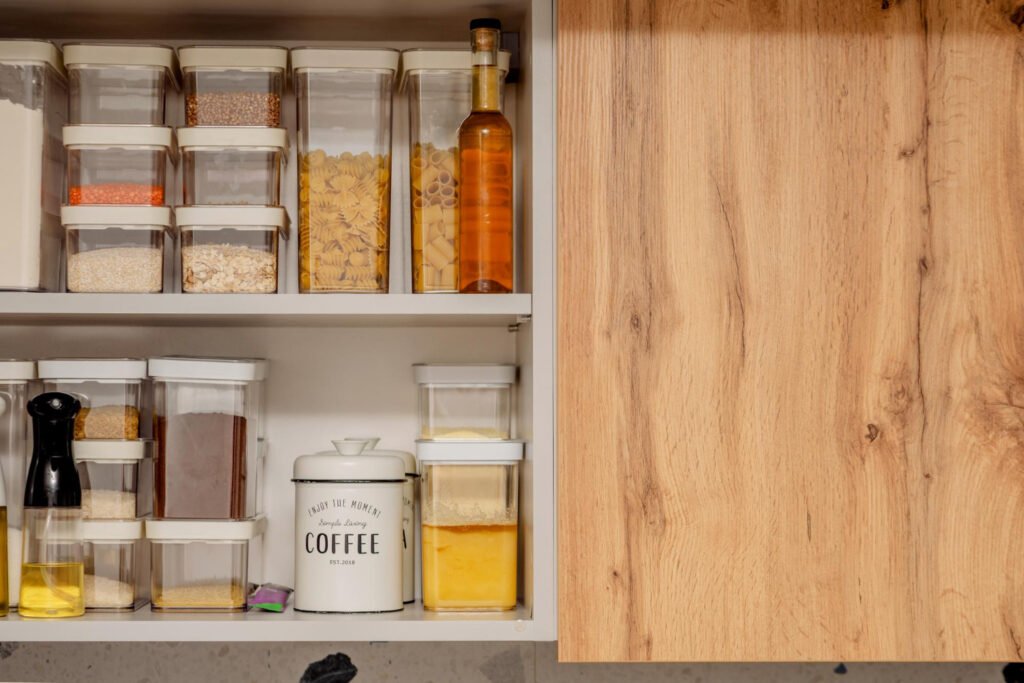
The organizational value of a kitchen cabinet is determined not just by its position within the zone system but by the interior solutions that make the storage it provides fully accessible.
Pull-out shelves are the single highest-impact interior upgrade available for base cabinets with door configurations. A pull-out shelf converts a deep, dark cabinet interior where items at the back are functionally inaccessible into a fully visible, fully accessible storage space where every item can be retrieved without removing anything in front of it. This is the interior solution most consistently requested by homeowners after they have lived with standard fixed-shelf base cabinets for any length of time.
Deep drawer configurations in base cabinets provide the most accessible storage format available for pots, pans, and large cooking equipment. A drawer full of stacked pans allows every pan to be retrieved by pulling the drawer open rather than by removing multiple pans to reach the one underneath. The time savings per cooking session is modest. The cumulative frustration eliminated over years of daily kitchen use is substantial.
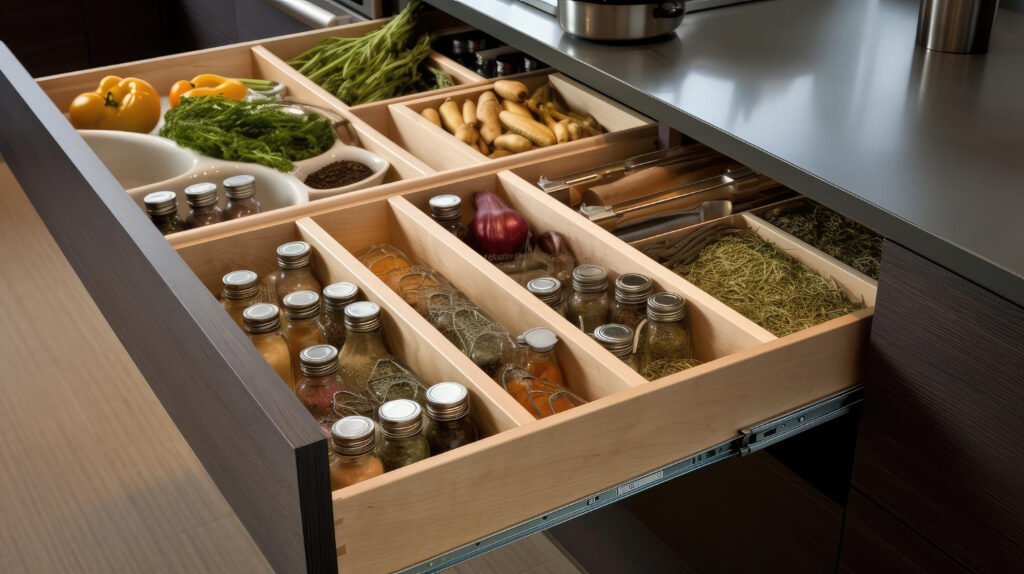
Drawer organizers in utensil and tool drawers convert the chaos of an unorganized drawer into a system where every utensil has a designated position. The most effective drawer organizers are expandable or adjustable configurations that can be customized to the specific utensils in the drawer rather than standard grid organizers that rarely align with the actual items being stored.
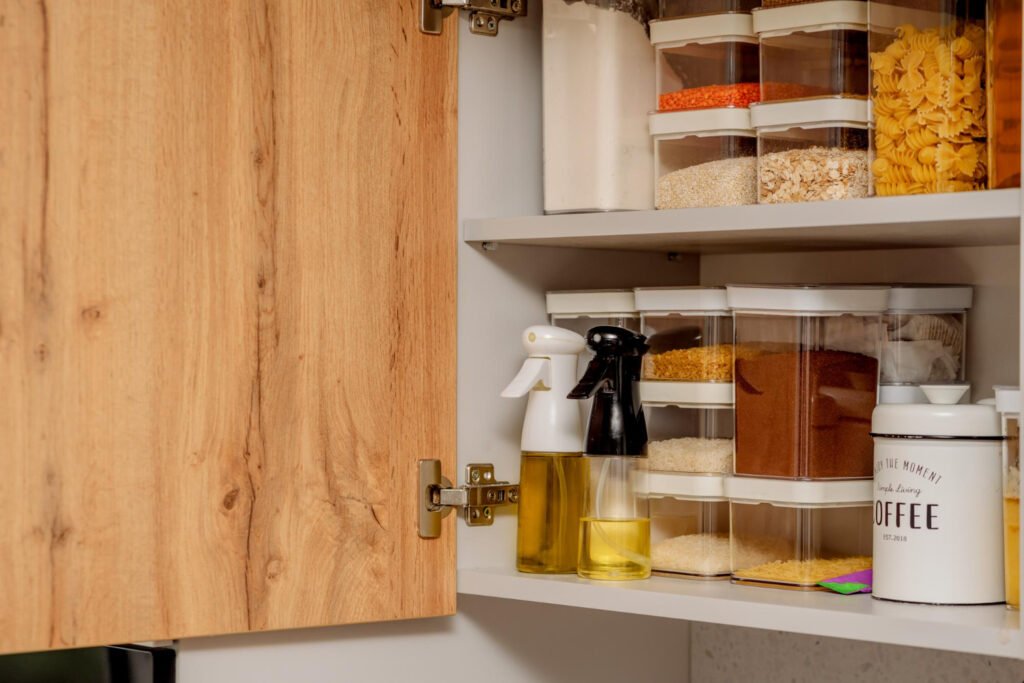
Door-mounted organizers on the inside of cabinet doors utilize the vertical surface area that fixed-shelf cabinets leave completely unused. Spice racks, small container organizers, lid holders, and cleaning supply organizers mounted to the inside of cabinet doors can add twenty to thirty percent of additional functional storage capacity to any cabinet without requiring any additional floor or shelf space.
Lazy Susans and corner pull-outs address the most persistently frustrating storage challenge in the standard kitchen layout, which is the corner base cabinet where items stored beyond arm’s reach are effectively lost. A full-extension lazy Susan or corner pull-out system brings the entire corner cabinet interior to the front of the cabinet, making every item accessible without reaching, crouching, or removing items stored in front.
Vertical dividers in wall cabinets and base cabinets create dedicated storage for cutting boards, baking sheets, pan lids, and other flat or thin items that are awkward to store in a standard horizontal shelf configuration. Standing these items vertically in a divided space rather than stacking them horizontally eliminates the extraction problem that makes stacked items difficult to use in daily cooking.
Planning Organization Before the Cabinets Are Ordered
The most effective time to plan a kitchen organization system is before the cabinet order is placed rather than after the cabinets are installed. Cabinet configuration choices, specifically the allocation of base cabinet positions between door-and-shelf configurations and drawer bank configurations, have a larger impact on the functional organization capacity of the kitchen than any interior accessory added after installation.
When reviewing the cabinet layout for your kitchen project with our free design service, bring your organization priorities to the conversation. How many cooking sessions per week does the household prepare? How much storage is currently dedicated to each work zone category and how much more is needed? Where are the most consistent friction points in the existing kitchen organization? These answers inform the configuration choices that make the new cabinet layout functionally better than the one being replaced rather than simply visually improved.
Our design team uses this information to recommend the drawer versus door configurations, the pull-out shelf positions, and the pantry cabinet placements that make the finished kitchen work for the specific household rather than for a generic kitchen user.
👉 Get Your Free Kitchen Organization and Design Consultation 👉 Browse Our Cabinet Configurations for Maximum Organization 👉 Order Sample Doors and Plan Your New Kitchen Layout
The Kitchen That Works Without Thinking About It
The best kitchen organization system is the one that becomes invisible because it works so naturally that nothing requires effort to locate. The pan is where a pan should be. The spice is where a spice should be. The glass is where a glass should be. Every session in the kitchen begins with what needs to happen rather than with a search for what is needed to make it happen.
This is not a complicated standard to achieve. It is a proximity and configuration problem with a straightforward solution. Map your work zones. Assign your storage categories to the right zones. Choose cabinet configurations that make every item accessible. And build the system once, correctly, so it holds for the next thirty years without constant intervention.