There is a room in most homes that gets used every single day, serves one of the most necessary household functions, and receives almost no design attention whatsoever. It is treated as a utility space rather than a room. Its storage is an afterthought. Its layout is whatever the plumber and electrician decided when the house was built, and nothing has changed since.
The laundry room deserves better than that.
Not because it needs to be beautiful for its own sake, although a well-designed laundry room genuinely is a pleasure to use compared to a cluttered one. It deserves better because the way a space is organized directly determines how efficiently it functions, and a laundry room that functions poorly adds friction to a task that most households perform multiple times every week.
Laundry room cabinets are the single investment that changes everything about how this room works. They create dedicated storage for detergents, supplies, linens, and seasonal items. They hide the visual clutter that makes the space feel chaotic. They give the room the organizational structure that turns an unpleasant chore into a manageable routine.
This guide covers every dimension of the laundry room cabinet decision — the configurations that work, the styles that hold up over time, the materials that survive the specific demands of a laundry environment, the layouts that maximize every square foot of available space, and the buying checklist that separates a cabinet investment that serves the household for thirty years from one that disappoints within three.
Why Laundry Room Cabinets Are Worth the Investment
The hesitation most homeowners feel about investing seriously in laundry room cabinets comes from the same place. It is not a room people see. Guests do not spend time there. The return on investment feels less obvious than a kitchen renovation where every visitor notices the result.
This reasoning misses the point entirely.
The return on a laundry room cabinet investment is measured in time, energy, and the daily quality of household management rather than in guest impressions. A laundry room with proper cabinet storage eliminates the hunting for supplies, the stacking of detergent bottles on the washer top, the pile of items that have no designated home, and the general sense of disorder that makes an already uninspiring chore feel worse than it needs to.
There is also a meaningful financial return. Homes with organized, finished laundry rooms consistently command attention in real estate transactions — particularly among buyers with families who understand intuitively how much a functional laundry room affects daily life. A laundry room with quality cabinetry, a folding counter, and organized storage reads as a premium feature in the same way a well-organized pantry or mudroom does.
The investment is not about making the laundry room beautiful. It is about making it work at the level every other room in the house is expected to work.
The Main Cabinet Configurations for Laundry Rooms
Laundry room cabinet layouts are more flexible than kitchen configurations because there is no standard appliance arrangement, no code-required clearance between cabinet types, and no fixed design hierarchy to work within. The layout that works best depends entirely on the size and shape of your specific laundry room and how the household actually uses the space.
Upper Wall Cabinets
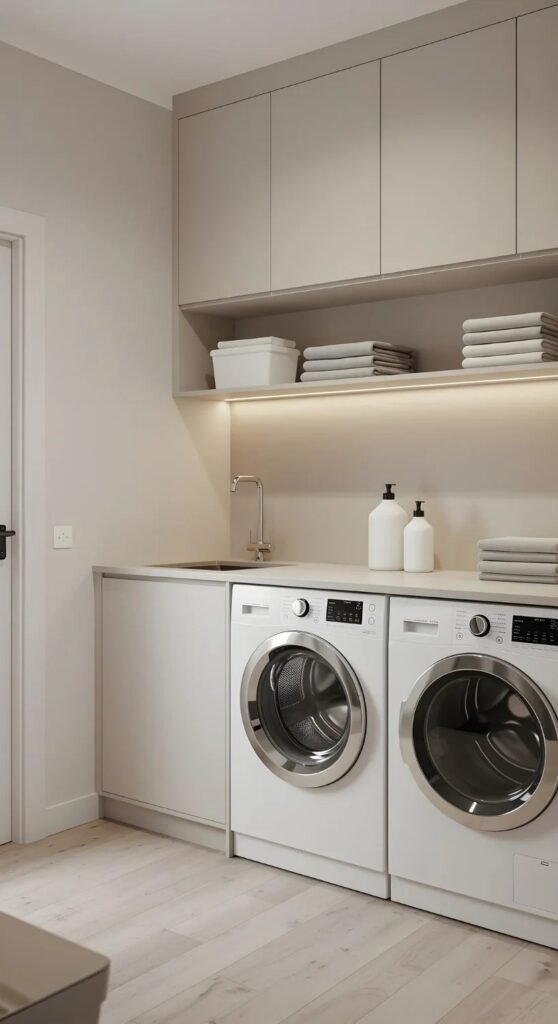
Upper wall cabinets installed above the washer and dryer are the most common and most immediately impactful laundry room cabinet addition. They convert the most underutilized space in the room, the wall above the appliances, into organized storage for detergents, fabric softeners, stain treatments, dryer sheets, and any other laundry supplies the household uses regularly.
The practical benefit is immediate. Every supply has a designated home above the appliance it corresponds to. The washer top and dryer top are cleared completely, which creates the folding surface the room needs without requiring any additional furniture or counter installation.
Upper wall cabinets in a laundry room typically run to a higher installation height than kitchen wall cabinets because laundry rooms often have higher ceilings and because the appliances they sit above are generally shorter than kitchen base cabinets. The additional height creates an opportunity for tall upper cabinet runs that provide substantially more storage volume than the same linear footage in a kitchen context.
Base Cabinets with Countertop
Base cabinets installed along one or more walls of the laundry room create a dedicated work surface that transforms how the room functions. A countertop installed above base cabinets provides a proper folding station — one of the single most requested laundry room features among homeowners who have renovated the space.
Folding on a purpose-built counter rather than on a bed, on the dryer top, or on whatever clear surface is available in the moment is a genuine quality-of-life improvement that is difficult to fully appreciate until you have experienced it. The organizational impact compounds when base cabinet drawers provide dedicated storage for small supplies, ironing accessories, or the miscellaneous items that tend to accumulate in laundry rooms without designated homes.
Base cabinets in a laundry room can also conceal utility items that would otherwise create visual clutter — cleaning supplies, extra rolls of paper towels, backup detergent, and any other bulk storage the household maintains.
Tall Utility Cabinets
Tall floor-to-ceiling utility cabinets provide the largest storage volume of any laundry room cabinet configuration and are particularly valuable in small laundry rooms where the floor footprint is limited. A single tall utility cabinet positioned at the end of a washer-dryer run provides enough storage for all laundry supplies, cleaning products, extra linens, and seasonal items without requiring multiple separate cabinet installations.
Tall laundry room cabinets also serve a practical purpose that no other configuration handles as well: housing a broom, mop, vacuum, or other long-handled cleaning equipment in an enclosed, organized space rather than propped in a corner or jammed into a closet elsewhere in the home.
Full Surround Cabinet Systems
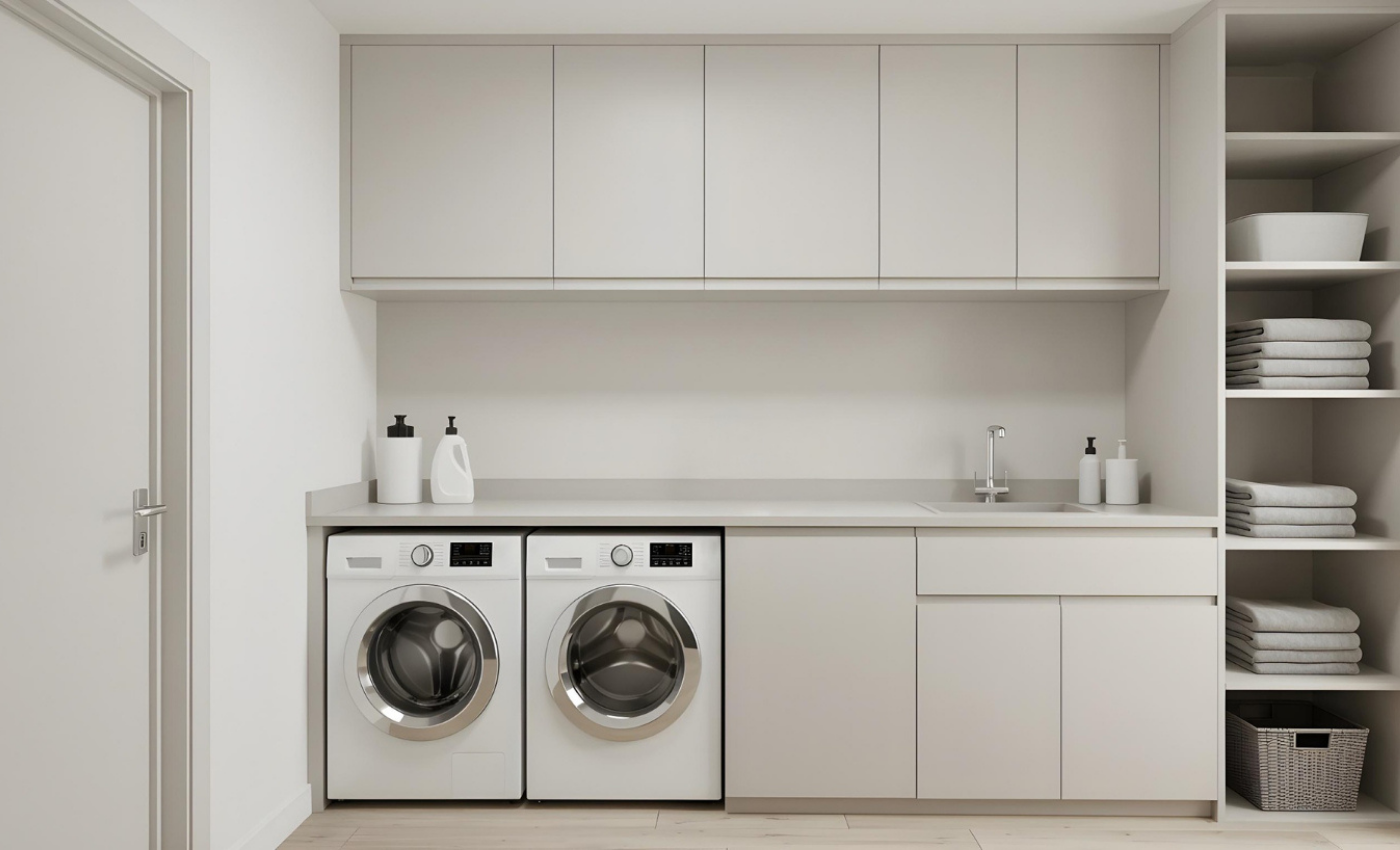
In laundry rooms with sufficient wall space, a full cabinet surround that combines upper wall cabinets, base cabinets with countertop, and tall utility cabinets creates the most comprehensively organized laundry space possible. The visual effect is equally significant — a laundry room with a full cabinet surround looks finished in the same way a kitchen looks finished, and the organizational capacity of the space increases dramatically compared to any single-element cabinet addition.
This configuration works best in dedicated laundry rooms where the appliances are on one wall and the remaining walls are available for cabinet installation. In combined laundry-mudroom spaces, which are increasingly common in new construction, the full surround approach creates an exceptionally functional transition space that serves the household in multiple ways simultaneously.
Laundry Room Cabinet Styles That Work in 2026
The style guidance for laundry room cabinets follows a different principle than kitchen or bathroom cabinet selection. Because the laundry room is a high-utility, high-moisture environment rather than a high-visibility design showcase, the priority order should be durability first, organization function second, and aesthetic alignment with the rest of the home third.
That said, choosing a laundry room cabinet style that coordinates with the home’s broader design direction creates a cohesion that makes the space feel intentional rather than improvised, and this matters for both daily enjoyment and resale positioning.
Shaker Style Laundry Room Cabinets
Shaker is as appropriate in a laundry room as it is in a kitchen or bathroom for the same fundamental reason. It is adaptable enough to work in any design context and timeless enough to never require updating. In a laundry room, the practical benefit of the shaker profile is that the recessed panel’s shadow line conceals minor surface marks and wear more effectively than a completely flat door surface.
White shaker cabinets in the laundry room create brightness in a space that is often undersized and underlit. Gray shaker cabinets bring a sophistication that makes the room feel designed rather than merely functional. Using the same cabinet style and color in the laundry room as in the adjacent kitchen or mudroom creates a visual continuity that elevates the entire utility wing of the home.
Our DDW Double Dove White and GR Shaker Gray both translate directly from kitchen to laundry room context with the same quality, the same finish consistency, and the same construction standards that make them the most trusted cabinet choices in our entire lineup.
Flat Front Laundry Room Cabinets
Flat front cabinet doors in the laundry room create the most contemporary aesthetic available and are particularly effective in newer homes with a modern design direction throughout. The completely smooth door surface is easy to clean, which is a practical advantage in a space where detergent splashes, dryer lint, and general utility room residue are daily realities.
Open Shelving as a Complement
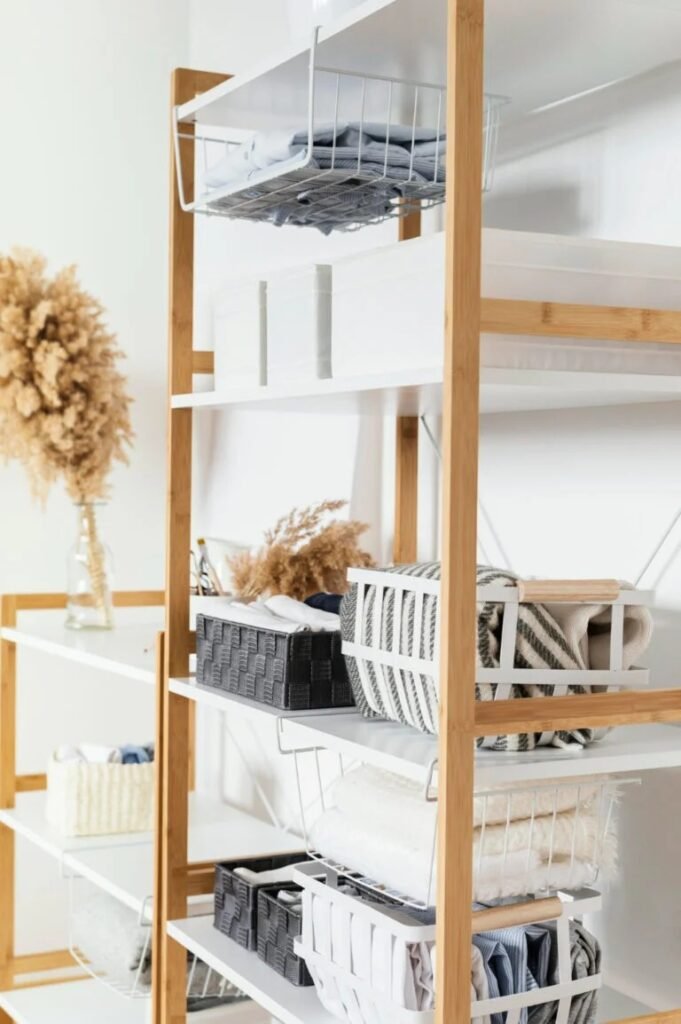
Open shelving in a laundry room serves a specific function that closed cabinet doors cannot. Frequently accessed items — the detergent used for every load, the dryer balls, the stain treatment spray — are best stored on an open shelf where they can be grabbed without opening a door. Strategically incorporating open shelving within a primarily closed cabinet layout creates the combination of organized storage and instant access that a high-use utility space genuinely needs.
The Best Colors for Laundry Room Cabinets
Color selection for laundry room cabinets follows practical logic more than design trend. The space is used frequently under conditions that are less flattering to cabinet surfaces than a kitchen — moisture, humidity, and product contact are all more concentrated in a smaller space with less ventilation.
White is the most practical choice for laundry room cabinets from a brightness perspective. Laundry rooms are frequently interior rooms without natural light or with limited window access, and white cabinets reflect artificial light more effectively than any other color, creating a brighter and more pleasant working environment. Our DDW Double Dove White in a laundry room brightens the space immediately and coordinates naturally with white appliances, which remain the most common appliance finish in laundry rooms across all price points.
Gray brings a more refined quality to the laundry room without sacrificing the visual brightness that the space benefits from. Medium gray conceals minor marks and residue better than white in a high-use utility context, making it the more practical long-term choice for households with heavy laundry room usage. Our GR Shaker Gray in a laundry room creates a space that feels considered rather than purely functional without requiring any additional design investment.
Navy in a laundry room is a bold choice that rewards the commitment with a striking result. A full navy cabinet surround in a dedicated laundry room creates the most dramatic and intentional aesthetic possible in the space. It works particularly well in laundry rooms that open to a mudroom or hallway where the bold color creates a deliberate design transition between utility and living spaces. Our NB Navy Blue in a laundry room context paired with brass hardware and white countertops is a combination that consistently generates genuine admiration from everyone who sees it.
Natural Wood tones in a laundry room bring warmth and organic character that painted cabinets cannot replicate. Our SWO Slim White Oak in a laundry room creates a spa-adjacent quality that transforms the experience of the space completely. Best used in laundry rooms with good ventilation and adequate sealing to protect the wood surface from the moisture that laundry appliances generate during operation.
Layout Planning: Getting the Most From Your Laundry Room Space
The most common mistake in laundry room cabinet planning is treating the space as whatever is left after the appliances are positioned rather than designing the entire room as an integrated storage and work environment.
Start with the appliances. Whether your washer and dryer are positioned side by side or stacked determines which wall or walls are available for cabinet installation and which cabinet configurations are appropriate. Side-by-side appliances leave wall space above them for upper cabinets and wall space on either side for tall utility cabinets. Stacked appliances free up considerably more wall space on either side for full-height cabinet installations.
Measure the available wall lengths, ceiling height, and the depth available for base cabinets given the floor plan of the room. Most laundry rooms have shallower depth available for base cabinets than kitchens because the appliances and their clearances consume more of the available floor plan. Standard base cabinet depths of twenty-four inches work in most laundry rooms, but twelve or fifteen inch depth base cabinets are available for rooms where the full depth would create a clearance issue.
Plan the countertop surface before selecting the base cabinet configuration. A folding counter needs a minimum of twenty-four to thirty inches of depth and at least thirty-six to forty-eight inches of linear width to be genuinely useful rather than merely present. If the room cannot accommodate a dedicated folding counter above base cabinets, a wall-mounted fold-down counter is an alternative that provides the surface when needed and folds flat when not in use.
Position upper wall cabinets at a height that allows access without straining. The standard installation height of upper wall cabinets in a laundry room is typically higher than in a kitchen because there is no countertop clearance requirement to respect. Cabinets can begin at whatever height provides comfortable access given the ceiling height and the storage volume required.
Lighting deserves deliberate planning in a laundry room cabinet layout. Under-cabinet lighting above the folding counter dramatically improves the functionality of the work surface, particularly in interior laundry rooms where overhead lighting alone is insufficient for the detailed work of stain treatment, sorting, and folding.
What to Look for When Buying Laundry Room Cabinets
The laundry room is the most demanding environment in the home for cabinet materials. Heat from dryers, steam from washers, humidity that varies significantly during and between wash cycles, and exposure to detergents and cleaning products create conditions that expose material weaknesses faster than any other residential application.
Plywood box construction is the non-negotiable starting point. The moisture resistance of plywood versus particleboard is more consequential in a laundry room than anywhere else in the home. Particleboard begins absorbing moisture and degrading structurally well before the visual evidence appears. By the time a particleboard laundry room cabinet shows swelling or surface deterioration, the structural integrity has already been compromised for some time. Plywood withstands the moisture variation of a laundry environment over decades in a way particleboard fundamentally cannot.
Solid wood door frames resist the repeated expansion and contraction caused by humidity cycles better than MDF alternatives. In a laundry room where the humidity can shift dramatically between an active wash cycle and a dry period, the dimensional stability of solid wood versus MDF becomes practically relevant over the life of the cabinet.
The finish topcoat on laundry room cabinets needs to handle not only moisture and humidity but also contact with detergents and cleaning products. A catalyzed conversion varnish finish provides the chemical resistance that a laundry environment demands. Standard air-dry finishes soften and mark when exposed to the types of cleaning products that are used routinely in laundry rooms.
Hinge and hardware quality should match the demands of the environment. Soft-close hinges protect the cabinet structure from the repeated impact of door closing in a room where cabinets are opened and closed frequently and often with hands that are wet or occupied. Drawer glides should be full-extension to allow complete access to cabinet contents, which is practically important in a utility space where supplies are accessed quickly and regularly rather than carefully.
Storage accessories within the cabinet are worth investing in for a laundry room application. Pull-out shelves in base cabinets allow access to items at the back without removing everything in front. Door-mounted organizers in upper cabinets maximize storage density for small items. Drawer inserts for detergent pods, small tools, and accessories keep the most frequently used items organized and immediately accessible.
Our Laundry Room Cabinet Collection
Every cabinet in our lineup that performs in a kitchen performs equally in a laundry room. The same plywood box construction, the same solid wood door frames, the same soft-close hardware, and the same durable finish standards that make our kitchen cabinets a trusted choice apply directly to laundry room applications.
The DDW Double Dove White brightens any laundry room and coordinates naturally with white appliances and light-toned utility spaces. The GR Shaker Gray brings sophistication and practical durability to a high-use utility environment. The NB Navy Blue creates the most dramatic and intentional laundry room aesthetic available. The SWO Slim White Oak delivers natural wood warmth in a space that benefits enormously from organic material character.
Free shipping on qualifying orders of $2,400 or more applies to laundry room orders as it does to kitchen and bathroom orders. Our free design service covers laundry room layouts with the same professional 3D rendering and precise cabinet count service that we provide for full kitchen renovations.
You tell us the dimensions. We show you the finished room before you spend a dollar.
👉 Browse Our Full Laundry Room Cabinet Collection 👉 Get Your Free Laundry Room Design Consultation 👉 Order a Sample Door Before You Commit